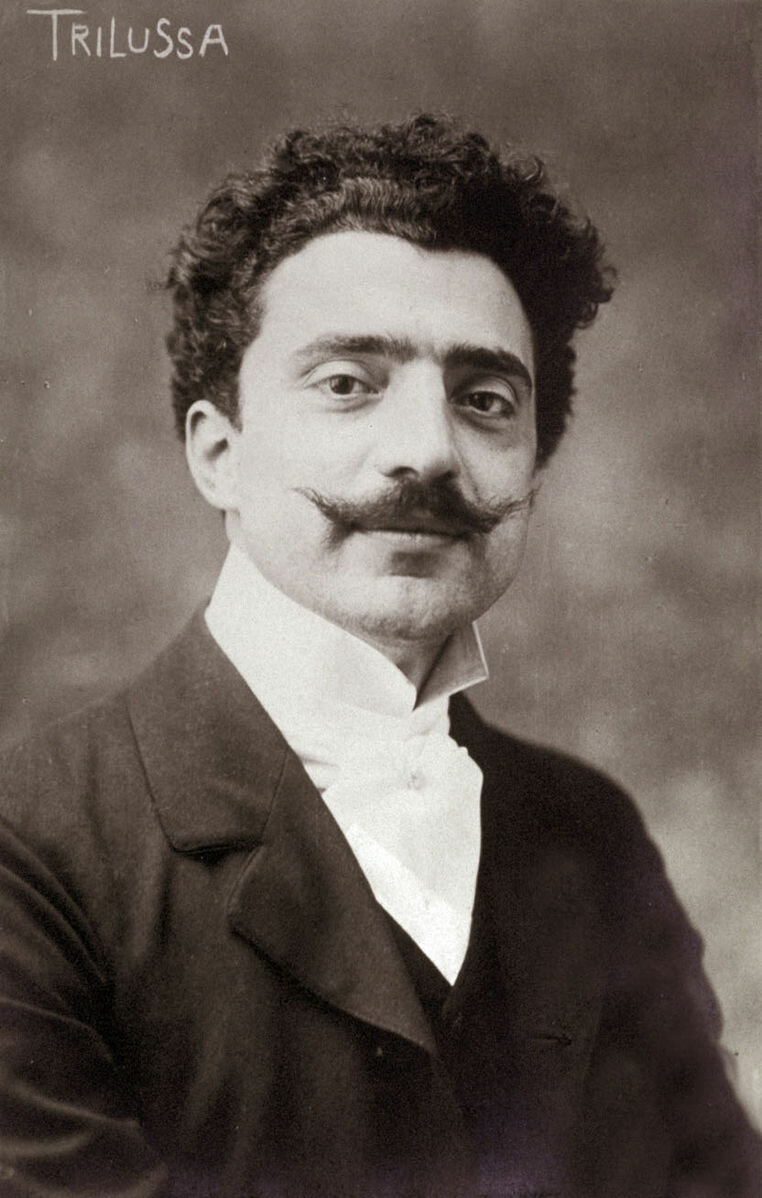
Carlo Alberto Salustri, better known by his anagrammatic pen name Trilussa, was a Roman poet and satirist (1871–1950). He witnessed fifty years of Italian history—from the Giolitti era through fascism to the postwar period—and used his work as a scalpel to dissect corruption, inequality, and political hypocrisy. Born into poverty, he never forgot where he came from, and his poetry became the voice of ordinary Romans against those who wielded power.
Trilussa deliberately rejected the conventions of high literary Italian, choosing instead the Romanesco dialect (or language as some would say) of the streets and working-class neighborhoods. This wasn't a limitation—it was a choice about audience and power. Standard Italian belonged to universities and literary salons; Romanesco belonged to the people who actually lived the problems he was describing. By writing in dialect, he ensured his critiques couldn't be domesticated or intellectualized away. They hit directly, in the language of the corner bar, the laundry, the market. His style was deceptively casual—accessible, even funny—but this very accessibility made his social commentary sharper, not softer.
“La Statistica” (The Statistics) is perhaps his most enduring work, and it cuts to the heart of how power operates through abstraction. In the poem, Trilussa observes that statistics makes everyone equal to the average, regardless of reality. If one person eats two chickens yearly and another eats none, statistics declares each has one chicken per year. The starving person is absorbed into the calculation. The system is satisfied with its own coherence. The violence of the averaging is rendered invisible. The following English translation cannot deliver the intimate yet powerful tone of the Roman vernacular, but keeps the message intact:
“Do you know what statistics is? It's a thing that's used to make a general count of people who are born, get ill, who die, go to prison and get married.
But for me the peculiar thing about statistics is the issue of percentages, because there the average is always the same even when someone has nothing.
Let me explain: from the calculations made according to current statistics it appears that you eat one chicken per year and even if you can't afford to buy a chicken you are included in the statistics anyway because someone somewhere is eating two.”
His Roman dialect insists on particularity: you—the actual person reading this—might be the one with no chicken. Modern data visualization and sophisticated statistical tools have only refined the machinery of abstraction Trilussa identified a century ago. We have better metrics now, yes. But we still mistake the map for the territory, the average for reality, the numbers for truth. Trilussa's challenge to us remains the same: look past the statistics. Ask who is included in this calculation, and at what cost. Because behind every average is a human reality that refuses to be averaged away.
The “chicken” example, however striking, captures in fact a rather simple socioeconomic phenomenon, namely calories intake. As Darrell Huff maintained in his 1954 book “How to lie with Statistics”, the more faceted a social problem the trickier the business of using simple statistical measures such as the (simple) average.
Yet the average of almost any phenomenon is the eye-catching measure. Take one of the most slippery concepts in economics theory applied to public procurement, namely competition. How to measure competition in public procurement? No matter how profusely economists have written in the past 70 years to adapt the concept of competition to evolving markets the concept seems to have been frozen in a rather simplistic approach, which boils down to measuring the number of bids in a competitive procedure: The higher the number of bids the more competitive the procurement procedure.
It does not help to flesh out subtler arguments such as that bidders are not alike – a bid submitted by a large firm is not the same thing as the one of a medium-sized one – or that a bid from a solo bidder does differ from one from a joint venture of firms. Only the absolute number seems to matter.
But here is where things become more intriguing. When browsing over the European Commission’s evaluation report of the 2014 Directive on Concessions, Public Procurement and Utilities (available at https://ec.europa.eu/transparency/documents-register/detail?ref=SWD(2025)332&lang=en) one reads that
“[…] with regard to competition and market outcomes, the 2014 Directives have been partly effective in maintaining competition in EU public procurement. While the average number of bids per procedure dropped from more than 5 to above 3, contracts exceeding EUR 20 million received an average of around 9 bids, the use of open procedures increased to 82% and the supplier base remains diversified.” (italics added)
This allegedly worrisome average number of bids should be read jointly with another alarming report by the European Court of Auditors where it is emphasized that during the 2011-2021 period, the average number of bidders per procedure declined from 5.7 to 3.2. And nearly 42% of all procedures had no competition whatsoever—just one bidder, or sometimes none. Meanwhile, single bidding almost doubled from 2011 to 2021.
This is Trilussa's paradox made concrete: the average number of bidders is 3.2, but this masks the fact that millions of euros in public contracts were awarded with zero competition. To get an average of 3 (plus a little something) you need to have more than 3 bids elsewhere. But where? Where, at least in principle, you would not expect more intense competition, that is, the one for higher-value contracts!
The evaluation seems to point toward a striking pattern: while overall competition has declined and the average number of bids is down, large contracts continue to attract robust bidding. This implies that smaller contracts are where the deterioration in competition is most severe.
The real question, then, is not whether the average is meaningful, but what it hides—and whether procurement governance is willing to follow Trilussa's challenge: to look past the numbers and confront the actual distribution of competition opportunities.